Not sure when all these posts were made - probably years ago, but I agree with @Rich, signalling on roundabouts is paramount to roundabout safety. As for the person who said that you should never give your left signal when entering a roundabout sounds like the ning nong I had a debate with from Wyoming DOT. If you give you left signal when entering the roundabout (in USA), the person entering the roundabout on the other side knows "not" to enter because you intend going past him/her and exiting at the next exit. By not signalling, the person on the roundabout could be exiting at the first or second exit, which means that you've sat there waiting when you could have entered the roundabout. A little complicated to write, but common sense for people who have literally grown up with roundabouts from other countries.
I mean, what would it hurt to signal - they're located about an inch away from the steering wheel!
Oh by the way have started a Facebook Page called "Roundabouts USA: Mission Possible" if anyone would like to join up. :-)
Roundabouts: reducing traffic frustration
By: Drivers.com staff
Date: Sunday, 30. July 2006
Visitors to Britain since the 1950s nearly always mention roundabouts as the most noticeable feature of that country's highways system. If they're drivers, their reaction is usually one of initial confusion, until they realize who has the right of way, followed by admiration as to how well the system actually works.
Now North American engineers, impressed by the efficiency and safety of modern roundabouts, are at last following suit. British Columbia has had some in place for a decade, and roundabouts have recently been built in California, Colorado, Florida, Maryland, Nevada, and Vermont. Many more are on the drawing boards.
According to the Turner-Fairbank Highway Research Center (TFHRC), the era of modern roundabouts began in the United Kingdom in 1956 with the construction of the first "yield-at-entry" roundabouts. In 1966, a nationwide yield-at-entry rule launched the modern roundabout revolution. Australia and most other British-influenced countries soon built modern roundabouts.
The research center, which is the home of the Federal Highway Administration's (FHWA's) Research, Development, and Technology Service Business Unit, has just published a highly informative booklet entitled " Roundabouts: An Informational Guide ." The booklet can be downloaded free from the center's web site.
The center admits that countries such as the United States, where people drive on the right side of the road, have been slower to follow Britain's example, but are rapidly catching up. For example, roundabouts have greatly increased in number in France since the adoption of the yield-at-entry rule on national routes in 1983.
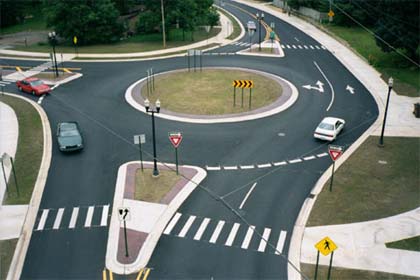
Okemos roundabout in Ingham County, Michigan, USA.
Photo taken by the Ingham County Road Commission.
"Yield-at-entry is the most important operational element of a modern roundabout," says the center, "but it is not the only one. Deflection of the vehicle path and entry flare are also important characteristics that distinguish the modern roundabout from the nonconforming traffic circle, which does not have these characteristics.
"Other features include splitter islands at all approaches (to control entry speed and deter left turns), good sight distance, good lighting, good signing, no crosswalks across the circulatory roadway, yield lines downstream of the pedestrian crossings, and no parking in the roundabout."
Why are roundabouts safer?
"The physical configuration of a modern roundabout, with a deflected entry and yield-at-entry, forces a driver to reduce speed during the approach, entry, and movement within the roundabout," the center says.
"This is contrary to an intersection where many drivers are encouraged by a green or yellow light to accelerate to get across the intersection quickly and to 'beat the red light' and contrary to old traffic circles where tangent approaches also encourage, or at least allow, high-speed entries."
Another important safety factor is that the only movement at an entry and an exit of a roundabout is a right turn, thus reducing the potential frequency and severity of accidents compared to accidents typically occurring during left turns and when traffic crosses an intersection in perpendicular directions.
It is thought that one-way circular intersections were invented by a French architect, Eugene Henard, in 1877. During the same period, the American architect William Eno was also proposing his plan for small circles to alleviate traffic congestion in New York City. Since the adoption of a yield-at-entry regulation in 1966 by Great Britain and in1983 by France, there has been overwhelming interest and research in roundabouts because of the simplicity of their design and operation and particularly because of their safety.
"Enthusiasm for the safety and high capacity of roundabouts has resulted in a huge increase in the number of roundabouts," the center adds. "By contrast, as growing traffic demand causes nonconforming traffic circles to fail, they are converted to other types of intersections."
In modern times, the Netherlands has experienced spectacular growth of roundabouts beginning in the late 1980s. In only six years, approximately 400 roundabouts were built. The reasons given are: a drastic reduction in serious crashes; lower driving speeds; improved pedestrian crossing facilities; elimination of traffic signals, and high capacity with more than 2,000 motor vehicles and several hundred bicycles and mopeds per hour in one-lane roundabouts.
TFHRC says the first modern roundabouts in the USA were built in the spring of 1990 in Summerlin, a rapidly growing planned community on the west side of Las Vegas. With rapid growth of the surrounding community, daily traffic has increased from very low flows to about 7,000 vehicles in the north roundabout and to about 11,000 vehicles in the south roundabout. Only four accidents have been reported at the two roundabouts over their five-year history.
The first modern roundabout on the California state highway system was installed by the city of Santa Barbara in 1992. The roundabout replaced an intersection of five two-lane streets regulated by stop signs. The old intersection averaged four accidents per year. Since installation of the roundabout, accidents have averaged 2.1 per year, with only five accidents reported in a 28-month period.
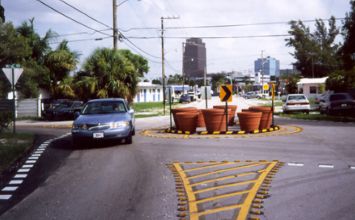
Photo courtesy Peter
Partington
One U.S. traffic engineer comes out resoundingly in favor of roundabouts over traffic lights. In a booklet prepared for the 1996 Roundabout Design Workshop in Montpelier, Vermont, Michael J. Wallwork says that for many years traffic signals have been seen by traffic engineers, officials, and the public as a panacea for traffic and crash problems at intersections.
"Often the traffic signals fail to meet expectations. They lengthen delays, the severity of collisions is likely to worsen, congestion and overall driver frustration increases with the proliferation of stopping points," says Wallwork.
"Traffic signals are ugly. They consume significant quantities of electricity, require costly maintenance, and often require traffic engineers to spend many hours in court, as attorneys for the plaintiff argue that traffic signals rather than any driver dereliction caused a crash.
"In their search for a better method to control conflicts at intersections, some progressive traffic engineers are now using modern roundabouts. The reason is that modern roundabouts are safer, cheaper, more efficient, have a higher capacity, and can be very attractive-especially as a gateway to cities and communities.
"I predict that engineers will increasingly realize that traffic signals are not the cure-alls that they have been promoted to be," Wallwork says." Roundabouts will be used in residential streets to reduce speeds and crashes, and on arterial roads to reduce crashes and provide a higher capacity. In all instances they are more cost effective and aesthetically pleasing, leading to public acceptance first, and public preference in the foreseeable future."
Further comments to this article have been disabled.
All Comments (89)
Showing 1 - 89 comments
 princesscaroline,
Contrarian,
Delightful. I might be convinced that these are a good idea, but only when my fellow drivers in the US learn the rules. I grew up in the Eastern US and people there had learned (over time) how to use a roundabout. Recently, these have been popping up in the West, one in my small hometown at the intersection of 2 city streets, in a residential neighborhood, no less! It might be just fine if there had been proper room to install this diversion device but at the intersection of 2 standard 2 lane roads? It's a mess, most people who once used these 2 streets have avoided them and that's probably fine if, as I suspect, that was the intent of the residents. I have slowed to enter this device (having right of way) only to be forced to slam on my brakes for a dolt who simply flies through without even looking right or left. They are the rule, not the exception.
I have watched buses, fire trucks and waste collection vehicles attempt to use this intersection (it is too small for any of these vehicles) with disgust and wondered what the public works department was thinking. There is now another proposed in an area where there is much more room and which is far better suited for such device............what's the result? The good proposal may be overshadowed by the really bad one already in existance.
crammer,
@AJP: the only problem with roundabouts is the adjustment period. after that, should be clear sailing (provided it was well-designed).
Dennis lawless,
Coming from the uk where roundabouts are all to frequent I think the USA have got a much easier road system having never driven anywhere but the uk I had a fly drive holiday in Orlando and after the initial nerves of driving on the wrong side of the road wore of I found the driving to be a more Pleasurable experience . The turning left if all clear on red is a great idea and should be used in the uk
AJ Pearen,
My region, the Region of Waterloo, has replaces traffic light with roundabout and driver are more frustrated and accidents are happening on a daily basis.
In fact they build on right beside a high school, now the students don�t have lights to support this safe crossing of the road.
Phil,
Nice name drop. "I have a BMW." I'm pretty sure all car repair is expensive. But thanks for letting us know.
Gary,
I'm glad that America has caught onto the roundabout. Intersections have a lot more potential for accidents than roundabouts. I'm glad because I have a BMW and sometimes BMW repair can be a hassle.
maya,
please i need an answer asap
maya,
hey i have a q how fast should you drive in a shopping center
Jim C.,
I've encountered about 5 different roundabouts in different U.S. cities, and gone through them a total of maybe 50 times. There were definitely moments of confusion, and several times I had to abort an exit because someone was in the way.
They require a level of alertness that can't be assumed to be present, especially when people are tired in the morning, or low-angle sun is blinding drivers.
I like the concept, but it does seem to be a safety risk with so many "me, me, me!" attitudes in this country, and tailgating is OK mentality. I can't compare them to any place else since I've never been out of the U.S. (after reaching driving age, that is).
There's one on Oak Grove Road in Walnut Creek CA that seems well-done, but it's not a super heavy traffic area that would really test safety concept. I personally think roundabouts should be limited to modest intersections or "T" crossings of medium-volume main roads.
I just don't trust my fellow Americans to be courteous enough in dicey situations, especially in ghetto type areas where people use their cars as ego weapons.
Rich,
The writers of the British Highway Code emphatically disagree with you, Alex, and they've got good reasons for doing so. The problem with the scenario you envision is that when you say that not indicating denotes that you will remain on the roundabout you're assuming that the drivers on the roundabout know the correct protocol and abide by it. We all know that's an unwarranted assumption in many cases. The benefit of signalling left is that it removes ANY ambiguity whatsoever. The Highway Code requires that if you are going more than halfway around a roundabout (i.e., in the UK that means turning right, and in the US it means turning left) you signal right (left in the US) at entry and maintain that signal until you pass the exit before the one you want, at which time you signal left (right in the US). This way every driver you encounter knows precisely what you are doing.
Of course, there's still the risk that you'll encounter a moron who simply doesn't care what the rules are. That sort of thing can never be eliminated. But one benefit of requiring the left turn signal is that if a driver then fails to use it, he's acting negligently and may be partially at fault in any collision that results. (Here in Virginia the doctrine of contributory negligence applies, which means that if the person suing was himself negligent, he cannot recover damages. Most states use the comparative negligence rule, which apportions fault between the parties.)
Roundabouts work best when there is no guessing, and it's unfortunate that so many Americans are too self-important to use their brains. They think that nobody else matters as long as THEY get through, never realizing that EVERYONE (themselves included) benefits when the traffic flows more efficiently.
I shall continue to follow the dictates of the Highway Code on this one. The Brits have FAR more experience with roundabouts and it's foolish for people here to think that we know better on this one.
L Keegan,
On roundabouts with two or less entry lanes, it is advisable to signal left to indicate to other drivers that you are not taking the first exit or driving straight through.
Alex,
@Rich
There is no reason to ever have your left signal on in a roundabout. Left signals do not indicate that you "won't be leaving" the roundabout, but not signaling right does. I personally hate when people use their left signal in the roundabouts as once you are in the roundabout, as long as you are not signaling to get out of it, you should stay in. For everyone wondering when to signal, signal right to get out of the roundabout, and only going in to the roundabout when turning right.
Subrena,
Do you have dvd on round abouts?
crammer,
@IAIN: agree its (usually) the driving at fault, but whoever likes to blame themselves, especially when its so much more fun to hold the government responsible of "unnecessary interference" and so on!
To help such drivers with roundabouts, here's an interesting animation (in French) designed to help automobiles, cyclists and pedestrians how to deal with roundabouts (and each other).
Then again, such drivers might more likely want to die than live constrained? (jab at NH)
IAIN,
I can't believe that amount of people who take issue with roundabouts.
I live in the UK and they are the easiest of roads to navigate.
Someone lower down the comments page commented that roundabout often have many lanes to them and are a nightmare to use. Why?
Like with any road layout, its more about the driver having lane discipline and knowing where they are going. Blame your driving, not the roundabout!
Rich,
I live in CA but come from England. Roundabouts are a cure for most intersections. Not all but most. The most irritating intersection in the US is the 4 way stop, normally followed by a 2 way stop so you are never sure if you can go or not. The roundabout negates that completely. Some people have mentioned that the US has semis that cant negotiate roundabouts. The rest of the world has semis too and they manage fine. I really miss roundabouts, they keep the flow of traffic moving. On the congested roads the roundabouts have peak time traffic signals. Like the freeway entrance lights. They are just about common sense. People that don't understand roundabouts should really think about whether they competant drivers or maybe need to take a refresher course.
whocameupwiththis,
I live in the uk and I detest roundabouts. I hope every one of them is destroyed. If everyone slowed down when approaching the roundabout, then everyone who was waiting at any point to enter the roundabout could get on and that would be great... but people dont slow down. People coming off more major roads dont even look for a second to see if anyone is trying to enter on their left (in front of them). If you are that person waiting on their left, you could potentially be waiting forever. It's so, so irritating. Also the way the road signs don't tell you compass direction or miles to destination, and speed cameras, and pretty much everything else about driving in the UK makes me want to gouge my own eyes out.
Brian from Indy,
Does anyone know of studies about the safety of pedestrians at roundabouts in the US? Thanks.
Ryan,
Roateries as they are called in Australia are becoming a real problem, you have to slow right down from say 65 mph to 15 mph then get back up to 65 again, what a waste of gas. Also they are hazardous for people in SUV'S as they can roll. What was wrong wwith the way it was using Intersections.
DK,
Curtis's example seems to me like a poor use of a roundabout and not the intended purpose, unless of course traffic in that tiny road somehow gets greater, or it's really hard for someone on the tiny road to cross the big road.
Curtis,
Roundabouts make sense sometimes, but..
Roundabouts are not the solution to every intersection. Where a little tiny road meets a big road, it makes no sense. Give right-of-way to the travellers on the big road, let the travellers on the small road wait. Here in Lexington, KY, there is an intersection that used to be a one-way stop and now its a roundabout. I used to be able to go by this little side-road at 55MPH, now I am forced to slow to 30 or so MPH and there is almost never anyone coming from the little side-road. So its a huge annoyance. Furthermore, I have had to slow to 5-10 MPH many times because the person in front of me was too afraid to enter the roundabout any faster than that. I liked it better before.
It seems like the traffic engineers in Kentucky use them as a way to be stylish rather than sensible.
Bill,
I believe one at five points would be worse than what is presently there. At least a traffic light only allows traffic when green.
hh,
i h8 roundabouts i britain they can have 4 or 5 lanes in a circle with traffic lights too. these are more dangerous than when there are no traffic lights because drivers change lanes suddenly
A,
The only thing with roundabouts is how easy they actually are when people know how to drive through them correctly...
Alamo Ron,
The following comments are for Alamo California, a small community with only one north-south street and a somewhat dense shopping area. A roundabout has been proposed for Orchard Court and Danville Blvd.
A traffic roundabout might make sense in certain areas such as the intersection of Walnut Avenue and Oak Grove Road in Walnut Creek (CA). That is a residential area but has a high traffic volume. It does not, however, have any significant "feeder" lanes near it.
The situation is dramatically different in down Town Alamo - there are a very high number of lanes from the shopping areas that feed into both sides of Danville Blvd. I question whether or not the roundabout will act as a "drip brewer" for traffic. Will it provide a constant drip, drip, drip of traffic and therefore not provide any breaks or gaps for traffic to enter Danville Blvd. from the shopping areas?
Properly designed, the roundabout may offer better safety for pedestrians who cross there. But pity the poor pedestrians who will try to cross both upstream and downstream of the roundabout - there may not be any gaps for a long time...
I'd like to see a couple of examples of successful roundabouts that have been placed in a busy shopping area with many feeder lanes like we have here.
Paula - MK UK,
Hi everyone, Milton Keynes in the UK has loads of roundabouts. It was designed with them and combined with grid roads (an idea from America) it allows for easy traffic flow even in rush hour. Trouble is now everyone is wittering on about using the car and the "environment" they are installing traffic lights at some - these are the ones where there are hold ups and congestion. Anyone who is against them hasn't driven the 15 miles to work in about 10 minutes in the rush hour and still with nerves intact! Roundabouts Rock!!!!
crammer,
Marshall: Your last sentence is a gem!
"US drivers [...] would prefer to die than yield."
crammer,
Chris: I think their "safety" concerns are from experience with the disastrous old traffic circles and (this is the part we can help with) lack of understanding the fundamental design differences.
All: I'm proud to report that Ottawa(Ontario) is seriously considering retrofitting modern roundabouts into certain collectors and arterials where traffic flow is an issue due to recent sub-divisions.
Chris,
I've read every entry here, and it amazes me the number of folks who don't want a modern roundabout because of "safety" concerns.
Study after study after study has proven that a modern roundabout, with good signage and good line-of-sight is substantially SAFER (in terms of accidents, injuries, and deaths) than your standard signalised intersection. They also dramatically reduce pollutants.
Marshall,
New Jersey had traffic circles as they called them, as far back as the late 1930s but motorists did not understand the unwritten rule of give way to those on the circle.
These work extremely well in the UK but not with the US drivers who would prefer to die than yield.
Bob Giordano,
I really think single laners are the way to go and the way to avoid multi-laners is to look at the whole transport system and increase transit, walk, and bike systems to the point that most arterials carry at most 16k cars. This will/does take a shift in american mobility consciousness. The safety at single lane roundabouts with design speed of about 16mph is great, so the shift is worth it. email me (Bob) at mist@strans.org with any thoughts.
crammer,
I take a a 2-laner on the way to/from work every day. Both lanes can exit safely when the drivers have enough practice, concentration and confidence in the other driver's skills. Most can do this quite effectively even if turn-signal compliance is only around 10%. Go figure!
Craig,
A stop light that only stops the speeders! That's great! But how do you implement it?
As for multi-lane roundabouts being confusing: yes there are some points of confustion, but doesn't everyone know that you have to be in the right lane to turn right at a signalized intersection, and you can't turn left from the right lane, or turn right from the left lane? It's the same with a two-lane roundie. Maybe it's the curvature that short-circuits our linear American brains.
Toria,
Been reading all this, finding it rather bemusing. I've driven loads in Europe and America. I love roundabouts; they are one of the best traffic-calming and time-saving ever.
Another problem is the design of many American vehicles for a couple of reasons:
- POOR HANDLING. Most are simply not built to go around corners at any speed, they are built for speed and comfort in a straight line. This is actually improving, although there's a way to go. Driving roundabouts in a car which handles nicely is really fun.
- RED indicator lights instead of ORANGE. Hence there is confusion between braking and turning. (I also loathe anyone who doesn't indicate at all, it makes the road so much safer. This happens everywhere though.)
The other traffic-calming system I know is a traffic light that only stopped you if you were going too fast, if you were driving at an appropriate speed, you would continue. Really cool. And worked brilliantly.
Joe,
As a Brit living in the USA for the last 10 years I am convinced that most road signage and a lot of road junctions here are designed by the blind.
Roundabouts do work where the law is enforced and the drivers are educated and tested to some common standard. My "driving test" in NYC took all of 10 mins , I didn't get out of 3rd gear and the 'test officer' couldn't even answer some of the basic questions I asked her about NY DOT regulations!
I think the previous comment by Rich about Virginia DOT saying not to indicate when turning left off a roundabout sort of sums up the basic problem you have. If the supposed experts haven't got a clue what chance is it that the practicaly untrained drivers are going to get right.
I'm sure you will get there eventually but it will be a bumpy ride!
Ryan,
There is a fool-proof system for double roundabouts, assuming that each entry-exit point is two lanes. If you are turning right (I'm assuming this is in N. America), get in the right lane. If you're doing -any other turn- get in the left lane.
This way, you can always turn right across the outer lane because anyone in the outer lane will also be immediately turning right.
Of course, this is fantasy la-la land because most Americans take either the "Charge Ahead And Do Whatever You Want" approach or the "Timidly Inch Your Way In and Pray" approach.
crammer,
good news: roundabouts seem to be gaining traction here in Ottawa, Ontario. City Council's recent decision to seriously consider roundabouts when planning/building new roads was widely publicized and there wasn't any backlash.
I just hope they don't try to go any bigger than two lane r'bouts though, which I think are just about the complexity that people (incl myself) can confidently take on, esp. after seeing a few minor accidents in a 2laner closeby.
Lance,
I think roundabouts are great for smaller intersections, but the multi-lane roundabouts with 4, 5 and 6 or more entry/exit points are extremely confusing and dangerous.
A 3-lane roundabout installed recently in my town is extremely confusing. The the signs are posted barely one hundred feet before entry. When traffic is heavy there is no time to get into the correct lane if you don't already know where to be. Once in the roundabout, there is no opportunity to correct being in the wrong lane. You are either forced to exit from the outer lane or circle endlessly in the center lane.
Once drivers have navigated the roundabout many times, it probably works for them, but it is a nightmare for first-time drivers and drivers who only use it occasionally.
It is my understanding that there have been MANY accidents since it was built.
Abdulrahman Zaid,
I have read all comments and I found most of the paricipants prefer roundabouts. For my self, I like to drive slowly'Drive slowly if you want reach your destination fast'
Advantages of Roundabouts:
1- Save lives, time, and fuel.
2- Less air pollution.
3- No maintenance
4- Slow driving habit
5- Less noise, etc.....
Disadvantages:
1- Lack of cooperation among drivers
Pedestrians can cross the road before the roundabout itself for all four sides with full land marks'Zibracrossing'with a sign indication slow down.
Near schools-we may use speed controls 'speed humps' to force the drivers to slow down.
For larger main roads, we may use larger roundabouts in diametre.
For countris with snow falling-The heat system may be used to keep melting the falling snw at roundabouts to make the road rough and clear.
I think more research should be made in roundabouts. Not to mention the currently design which we include tunnels and bridges to the roundabouts.
Finally, less road marks would be very good to keep the driver concentrates on the road.
No to Traffic signals but Yes to Roundabouts.
Thank you and good luck to all.
If you have any question/suggestion regarding roundabouts, please email me at: lhenboss@yahoo.com
Simon from SoCal,
When comparing a single lane roundabout twith a 2 lane road with left hand turn lanes in each direction, single lane roundabouts can handle the exact same traffic. I can prove this and have in Orange County, California. This is the very place where people are thought not to be able to drive roundabouts. So even during peak times, roundabouts can handle the traffic just fine. As far as pedestrians go, it is not safer for pedestrians to cross over multiple lanes because the distance is way too far and cars can't see them through all the lined up cars in multiple lines. If you don't agree with this, just look at Avon/Vail, CO or Clearwater, FL. Many case studies have been done for both and these claims can be verified.
Jerry,
I live in a community which is being subject to the callus development of the resort mentality. There is little concern for residents in an age where development should be focused on aligning itself with the communities behind mainstreets.
Small buisness will be pushed out to pave way (no pun intended) for GAP stores and Chili's Restaraunts. Darn!
I am interested to learn more about Katie's report on US 23 and Lee road.
Please contact me at
Jerry,
Roundabouts are not a blanket solution to traffic calming. In addition to the fact that the Federal Highway Administration does reconize the difficulties for childeren an elderly croosing, due to the lack a breaks in traffic at peak hours, Roundabouts DO NOT ALWAYS HELP TRAFFIC FLOW AND IN CERTAIN CASES CAUSE TRAFFIC TO BE DIVERTED INTO RESIDENTIAL NEIGHBORHOODS. Andrew of the UK pointed out the problem with a roundabout where a less busy street meets a main street. This is a formula for a traffic jam.
Simon from SoCal,
One by one, I've been educating people and convincing people in Orange County that Modern Roundabouts are the way to go. I tell them how silly the hurry up and wait system is and how silly it is for people to NEVER allow any space infront of them because what if someone beats to the light and therefore makes the light before it turns red. All nonsense. The roundabouts encourage average speed driving, as do our freeways. It allows for smaller roads, safer pedestrian crossing, beautiful intersections (when's the last time you heard that being said about a traffic light intersection?), and also and again, it encourages AVERAGE SPEED DRIVING. The person who loves to look at his speedometer and see how high it goes will forever hate roundabouts, but the person who loves to look at their watch will forever love roundabouts. I've been doing my part in promoting them because they are obviously better yet people are ignorant to them. I've created a couple myspace pages for roundabouts and good driving habits in general:
myspace com gooddriver
-- and ---
groups myspace com /gooddriver
--- this one has a message board place for people to chat. I'm hoping I start to see people using it! :) ---
Rich,
Part of the problem in the USA is with people not indicating (using turn signals). I live in the Washington DC area, and as you may know DC has plenty of the older traffic circles, many of which have traffic lights, multiple carriageways, exits that cross each other, and other oddities (at least one requires traffic already on the circle to yield). The single biggest problem at every DC circle is with people not indicating, because it freezes entering traffic. You never know which way other drivers will go, so you can't enter the circle unless you are certain the driver is leaving.
To underscore the problem, the Virginia DOT recently put out some guidance for motorists using roundabouts, but they botched it because they do not instruct people on how to indicate for a left turn. VDOT's instructions for approaching a roundabout:
(a) If you want to turn right (take the first exit), indicate right and stay in the right lane. So far, so good.
(b) If you want to go straight (take the second exit), don't indicate, use either lane, and indicate right after passing the exit before the one you want. Still good.
BUT
(c) If you want to go left (take the third exit), approach in the left lane, do not indicate, and then indicate right after passing the exit before you want.
VDOT is wrong in suggesting (c). The British Highway Code's equivalent for a right turn is the far superior way of doing it; adapted to a left-hand drive country, the method is to approach in the left lane AND indicate LEFT until you have passed the exit before yours, then indicate right. Indicating left is very important because it tells everyone that you will be staying on the roundabout. If you don't indicate, then it's not clear when you reach the second exit whether you are continuing around to the third exit or whether you are taking the second exit and you just forgot to indicate. VDOT's method forces other drivers to guess at what you are going to do, and the whole point of the roundabout is that they work best when people don't have to guess.
Unfortunately, people in the DC area think they're too important to obey any of the rules. We could save astronomical amounts of time if we tore out most of the all-way stops and many of the traffic lights, but I'm not optimistic. VDOT's answer to every problem seems to be to throw up a traffic light.
Derek,
I agree with Chris the Atlanta bus crash was caused by crazy road design. I've been in those HOV lanes that exit left. sometimes they go up ramps to an elevated lane. They should NEVER end abruptly at a stop sign
chris,
we have a roundabout next too an elementary school. I consider it safer because each road is divided into 2 lanes with a LARGE trafic island in the middle so pedestrians just have to walk across a lane 8ft wide and cars have to yield.
There is no way that this is less safe than the standard intersection at the other corner. The road is about 30ft wide and often cars try to pass through when a pedestrian is 1/3 of the way across.
I consider the US intersections system to be far more dangerous, especially when you get a right turn green light only to find a pedestrian white light to walk. I lost count of the number of time this nearly caused a pedestrian accident. A green light should mean just that, you can go, anything else is just plain dumb and an accident waiting to happen especially in winter when it is dark and people not wearing reflective clothing.
Chris,
Consider the advantages of roundabouts:
Fewer accidents
Less time traveling to work
Less wear on your car and brakes
Far better fuel economy
Greener - not requiring bright traffic lights 25 hours a day
So why they dont use them?
My theory is that they dont want to spend public money on something that costs more to build up front.
I refuse to believe that they are less capable drivers in the usa.
Chris,
It seems they will do anything they can think of to avoid using the superior roundabout system.
Chris,
I heard about the sad accident where the bus was travelling in the multi occupancy lane at high speed in some US city metro area. The road designers had the lane go up onto a ramp and then just stop! The bus flies over the top of the bridge and falls to the concrete far below. This is utterly beyond comprehension. This was an accident waiting to happen. Dont they think about the roads they design and use some kind of nation standard system? This was the only design of it kind on teh planet.
Dan,
Esther, there's a national conference on roundabouts coming up on Kansas in May 2008. You might contact the organizers about your question.
Esther,
Have any roundabouts been built right next to an elementary school? Our community is up in arms as a roundabout is being built at an intersection with an elementary school at one of the corners. Our main concern is the safety of our children. Any suggestions/recommendations? One child hurt is one too many.
Andrew Cope (UK),
Roundabouts work very well for most junctions but break down badly during very heavy driving conditions particularly where a minor road crosses a major road.
They do also require driver education and favour experienced drivers that can think and plan ahead. Even in countries used to them though plenty of drivers don't think about the roundabout until they are about to enter it.
Ideally you should be looking at the traffic on it as soon as you can see it, planning your route through as you approach the entrance. That way you can match speed and lane so as to merge in like a tooth on a cog.
Sadly doing that often relies on other motorists indicating their intentions correctly and quite a few people don't.
crammer,
Dan, I agree with you when you say "the former is far superior" but I wonder what circumstances you refer to that might preclude the installation of a roundabout?
Dan,
Diana, From what you say about the intersection you describe I suspect that there are reasons why traffic has problems. You said "rolling". Does this mean the intersection is at the bottom of a hill or in a hollow? From my experiences with intersections and with roundabouts both in North America and Europe I see a tendency for traffic engineers to put up signs and assume they've done their job of communication. Sometimes much more is required. I believe Europeans are much better at communicating with traffic.
As for my preference of roundabout or stop sign, I believe the former is far superior when the circumstances permit it.
Don L. Page,
I own property on a major intersection of a State highway and a county road in California. We have been in the process of site plan approval at the intersection for over 4 years while the state's engineers get themselves informed. They are finally on board with my engineers. Of course they and the county want us to foot the bill. I only tell this story because once the state wakes up to superior safety and traffic flow and lower maintenance costs, many more will be built in California. All will benefit!
Diana,
Hi there. My town is in a big debate over installing a roundabout on a rolling county road. Many residents agree that something needs to be done, but many argue that a roundabout is not the solution for the traffic issue that exists in our town. The intersection is viewed by some to be very dangerous. Many drivers who enter the intersection neglect to obey the stop sign and speed right into oncoming traffic. During peak commuting hours the stop sign at this intersection brings traffic to a grinding halt causing cars to line up for nearly a mile. The town responded to the traffic back up by posting a traffic officer to direct traffic through the intersection. Unbelievably there have been several instances of individuals speeding past the stop sign, entering the intersection and nearly striking the traffic officer. The residents recognize that something must be done and are asking for this issue to be rectified. There are many supporters for a traffic light and there are many supporters for a roundabout. Those who argue for a traffic light say that a light is much safer, will prevent accidents and will save lives. Those who argue for a roundabout say that the roundabout will allow for traffic to flow, will slow drivers down and thus will reduce the potential for accidents. After having some harrowing experiences myself with near hits in this intersection, I am more inclined to believe that a roundabout may be a more plausible solution versus a light. If drivers currently do not heed a stop sign, then there is a strong possibility that they will not heed a stop light. But that aside, many supporters of a traffic light say that snow will be problematic in a roundabout. They also say that emergency services will have difficulty negotiating a roundabout. The individuals who speak of these points are not professional traffic engineers and chances are that they have never driven a roundabout. I am looking for candid feedback from individuals who have experienced driving roundabouts in snow. I would like to know how the roundabout is maintained in a snowstorm and how frequently or infrequently are there accidents in the roundabout.
Jane,
With 4 way intersections you have to watch every entry to see if someone is at the line first and then you think was it me or was it him first. Then you inch out warily, then you stop then you start and eventually you get across. Then you repeat 200 yards further on at the next one and you add 30 minutes to your journey and wonder why your kids are coughing up and asthmatic from these 5L SUVs that stand still. I am so glad I live in the most technologically advanced nation on earth and really hope they dont spend the money to put these crazy roundabouts on our roads.
Jade,
Well if the American intellect is not sufficiently high enough to be able to deal with a simple roundabout then what can I say... They can put men on the moon and design computers, but not navigate rounabouts. I am speechless... Actually part of the reason is because they are so lax when it comes to driving tests.
Chris,
Having driven in BC now for 5 years I have to say that the North American 4 way intersection/crossing is by far the dumbest thing I have ever seen on any road anywhere. Whoever invented must have lived in the middle of the praries and sure that works fine but not in the cities. I have now been rear ended 5 times at these 4 way intersections in 18 months. It is insane. People get so frustrated having to take about 2 times longer to get from A to B than in the UK AND they plow into people who are queuing. Look at the advantages of roundabout, no queuing and waste greenhouse no lights that burn electricity and go out regularly every winter and dont worry about learning to use them, they are SO easy you just look to your left and if someone is coming you stop. THAT IS IT! I suspect that they are lagging on this because of money. In general they are not spending as much public money on their roads because it is against the capitalist philosphy.
Zach,
Katie, you must live in the Livingston Co. Area. If you do, did you hear the news on WHMI with all the people who live on Old Lee Road who are complaining about the huge increase of traffic because of people avoiding the dual roundabout?
Katie,
Im currently writing a problem solution essay on the roundabouts at U.S. 23 and Lee Road. I think it was a rediculous waste of money, and when winter really hits, we're all screwed. I personaly dont plan on doing much shopping at the new Green Oak Village Place mall because of them.
Zach,
The head on collision was in a double roundabout on snow-covered roads. Someone driving on the West roundabout was going to the center roundabout and hit ice, as someone was going round the center roundabout. Meaning, head-on collision.
And the roads weren't THAT bad. I mean, there were spin-outs, but nothing serious.
And the Road Commission is still doing studies on how to reduce the accidents on them, which average about one accident per day.
crammer,
How the heck do you collide head-on in a roundabout?
Unless the driver(s) were totally dumb-a55 (in which case they shouldn't be allowed on public roads - or in public in general), if the road conditions were so bad, how many head-on (and other) collisions would there have been were it NOT a roundabout, eh?
Zach,
One of the biggest problems we have with the round-abouts up here is lots of Semis and trucks with trailers end up using the single and double roundabouts, and end up taking both lanes when trying to make a turn.
And as I said earlier about the first winter of this double roundabout, there was a head on collision after the first snowfall.
On a lighter note, the local radio station is awaiting conformation from the Guinness Books of world records because they were attempting to break the record of time stuck in a double-roundabout.
Wheelnut,
We could all take a lesson from "zipper" merging in Germany. Merging lanes of traffic flow together like the two parts of a zipper. It's quick, efficient and safe, but it takes gettign used to.
Carl,
As drivers get mmore aggressive, fewer are yielding a the roundabout in Corvallis. Maybe because most people living there are carpetbaggers from Cal.
Prof Peter Russell,
We have used roundabouts successfully in the UK for more than 60 years. all that is required is for drivers to look at where their own danger is most likely to come from (in the UK where we drive on the left - this is to give way to the right). in countries where they drive on the right, then all you have to do is allow all traffic that is already on the roundabout to go before you follow them. if the traffic is 'balanced' there is no problem. If the traffic is much busier on one road, then it is logical for that traffic to have greater priority.
Peter Russell
Professor of Road Safety Education
DRIVER EDUCATION RESEARCH FOUNDATION
ENGLAND SO18 1JB
joe shmoe,
I think roundabouts are an awesome idea. I don't know much about them, there are only 3 or so in Winnipeg, but I still think they are great.
Dieter Fischer (Aus),
Roundabouts are suited better where traffic drives on the left (UK, Australia etc) because we don't have to change the 'yield-to-the-right' rule. It get's complex, when there are two or more lanes and you want to leave a roundabout.
But generally, I think they are safe and more efficient than traffic lights - no unnecessary waiting time. The only roundabout in the US I saw was at Seal Beach, near LA. I was amazed.
Dieter Fischer, Driving Instructor, Adelaide
parked4 now,
roudabouts are crap. we now have 2 in abbotsford, now the other streets are worse because lots of people avoid them . well done guys ...22 million pissed away...
Lil trucker,
I think maybe Zach is on to something. There probably isn't much snow in Europe and the roundabouts work better. However, as trucker, I like them.
Zach,
I can't wait until winter comes and snow covers all the lines and signs. It'll be a field day.
Crammer,
This one old roundabout I know of in Ottawa is stupid, as it makes rotary traffic yield to entering traffic. How retarded is that!
Kanata (west of ottawa) is still building more roads with traffic lights. ARRGGGHH!
Meanwhile, there's a major (4-lane) boulevard being extended in Gatineau and they've got at least four modern roundabouts in service and more planned - it's so much fun to zip through them!
Montreal built several traffic circles in the 60's, with tangential on-ramps. Rotary traffic had to merge with incoming traffic at 100kph (posted limits are less but nobody cares), so they put traffic lights. Please nuke em all and build them back but right this time!
Brian,
Great comment BH!
I wonder if anyone has any stats on crash rates at intersections in the UK where roundabouts are very common versus in North America where they are uncommon.
BH,
I love roundabouts but there aren't many in Ontario. The only city that's really embraced them on a large scale is Kitchener-Waterloo. None of the provincial highways have them yet, just county/regional roads and urban streets.
I'd really like to see more roundabouts replace traffic signals at rural intersections. It's easy to get into an accident when a driver going 100 km/h suddenly has to stop. It's much safer when every driver does the same thing every time they approach the intersection.
KenSolar.com,
I think Roundabouts are great. Less sitting in traffic, less maintenance, less pollution due to increased gas mileage, less time to reach your destination, less affected by hurricanes (electrical outages etc), and my favorite reason for loving them.. they're much quieter. There is an adjustment period for people who are used to traffic lights and control systems like that, but well worth it in the long run. 20 people stomping on their gas pedals when a light turns green (especially buses and dump trucks etc) is a lot noisier than the occasional honk in a roundabout.
Roy,
There have been modern roundabouts in Edmonton, Alberta (Canada) since the 1950s. By and large these work very well, and in one circumstance one is necessary to accommadate the intersection of 5 major roads. Although several were removed in the 1970s and 1980s due to inability of drivers to navigate them without crashing, the remaining 5 continue to serve the city well. A roundabout has recently been installed at the rural intersection of two major highways in southern Alberta with success. The concept is simple and elegant, and only breaks down where poorly informed drivers mess up the works. I for one applaud the addition of more roundabouts to the North American traffic system!
Nathan,
I live in Forest Lake, MN and our city council is planning on spending $20 million plus on tearing up our main street to install 8 roundabouts in less than a mile. Does anyone else know of an example (doesn't have to be the U.S.) of where this has worked in the past? I worry about pedestrians, traffic off the interstate (two are planned on the off ramps) and wasting money on a project that may not solve our traffic problems - this is supposed to last until 2028! Thanks
Brian,
Roundabouts work really well in the UK and Ireland, even very small ones, so stops signs are not very common. However, the protocols amongst drivers are very well worked out and practiced by now, so roundabout traffic interactions are smooth and frictionless. I believe it save lots of frustration and fuel as well as wear and tear on vehicles. The key to smooth interacton is that traffic in the roundabout has the right of way.
Sometimes the signs are complicated so you have to go around more than once to read them. That's OK.by me.
Bob Miller,
The concept only works when the drivers are sane. This is why rotaries in Massachusetts are dangerous.
Dan - Drivers.com,
Zach, We've noticed more roundabouts appearing in north America and they take time to get used to. If the signs are bad that makes it even worse. I saw one near Boston last year which had a sign you couldn't see until you were half way around. You wouldn't happen to have a photo of the one at Old US-23/Whitmore Lake Rd and Lee Rd.
Perhaps we could use it for a followup article on signs and roundabouts.
Cal,
I hate Roundabouts, they are awful, there is one near the post office by my house, I would love to ring the neck of the city planner that it put it there.
Zach,
Yes, roundabouts are easy, but has anyone tried to drive a double-roundabout. The first one in the United States is at Old US-23/Whitmore Lake Rd and Lee Rd., with access to US-23. The signs make no sense, and the drivers have no clue where they're going, or how to drive the roundabout. I'm sure in England, they work fine, but they've drove on them for years, where as Americans have just started to see them.
john,
roundabouts could not be simpler. If you look at the top photo you can see that the white car has just joined the roundabout. The white car would have needed to wait until it was SURE there was no danger from traffic coming from the left. If there is no traffic coming from the left you need not stop but just 'zip' onto the rounabout and away you go!
The only conusion is with larger two or three land roundabouts. Generally if turning left (which is the 2nd exit on the top photo) you need to be in the left hand lane. If you are turning right (no right exit on that photo) or going straight on you should be in the right lane.
NB it always pays to indicate on a roundabout for safety reasons.
Frank,
Maybe they're confused. I know of one in Toronto, Canada where there's a roundabout with a 4-way stop sign!!!
I'm not convinced traffic sign people really know what they are doing - but I'm open to explanations.
Reuben5373,
Just as long as you guys do not make the same mistake Ireland did. We have used them for as long as the UK but some genius thought it a good idea to stick traffic lights on some of them??? Not many but enough that these ones are only quiet when the lights do not work!
Frank,
Exactly right. there are more traffic roundabouts now bit for years they were neglected. I know of one near Niagara Falls which was there years ago but not now. It was a roundabout, but traffic on the roundabout did not get the right of way and that screwed it up.
JOhn,
Well what took north america so long to realise the benefits of roundabouts? If the UK has been using them for 50 years and had enormous sucess it serves as proof as to their superiority. Perhaps its the USA's willinglness to disregard europe and scoff the UK that has lead you to use the ineffective and costly traffic light method. However I admit that the UK has a much higher congestion rates and so a effective solution, in roundabouts, was required.