I have driven in Russia and beyond since the 1980's _ Personally I never have had any difficulties from Lithuania /Latvia to alama Ata or even down to Samarkhand. Or Other States that I have driven. Like all places you have to be careful and with your wits about you. Love the country
I drove HGV trucks!!!!
Driving in Russia: rules and reality
By: Michael Shipley
Date: Tuesday, 28. November 2006
After a mountain of rules to get a license, Russian roads require survival skills
"Hey, where'd that guy come from?!"
"He's not supposed to do that!"
"Oh my gosh, I almost hit that kid!"
These are but a few of the exclamations my Russian wife gave voice to as she drove through our small Siberian city of Chita for the first time. What had in her pedestrian youth appeared as peaceful little roads and by-ways, became behind the wheel of a car a nerve-wrenching gauntlet of seemingly blind pedestrians and careless drivers. Thus began her induction into the "anything goes" world of driving in Russia.
My wife's surprise at the general lawlessness of Russian roads was heightened by the fact that she'd only just mastered a mountain of theory in order to earn her driver's license. Along with a growing number of Russians who yearly join the motoring ranks, my wife had been required to memorize the answers to an amazing 800 questions dealing with every imaginable driving rule in the book. But out on the road she discovered that, in Russia, theory and practice are at best very distant cousins.
Consider, for example, the painted line down the center of the road; in Russia one only rarely encounters it. And without that outward symbol of restraint, drivers often pass freely across the center quite regardless of oncoming traffic, blind corners or other annoyances. Government cash shortages in part account for the problem. A bucket of reflective paint can cost more than the monthly salary of the person who applies it. At stoplights, drivers jockey with each other like NASCAR racers jostling for the pole position, each striving to be first out of the chute. Add to that a similar attitude on the part of pedestrians attempting to cross the street, and you can imagine the potentially deadly mix of conflicting intentions.
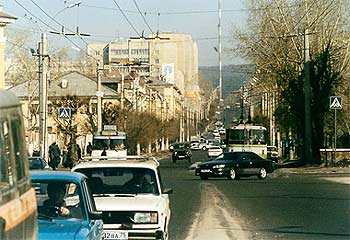
City of Chita in Eastern Russia, about 900 miles (1,400
km) north of Beijing
"Don't worry," I told my wife. "Soon you'll anticipate and react to all these factors automatically." Like a war veteran waxing nostalgic, I flashed back to memories of people stepping in front of my moving car as if crossing an open field rather than a busy city street. "But I'm so nervous and stressed," my wife complained. "Welcome to driving in Russia," I told her.
After more than four years behind the wheel in Russia-which included one year navigating the convoluted Moscow street maze-I greeted with more than a little anxiety my wife's new role behind the wheel. With a population of 350,000 in Chita, there are 65,000 personal cars. Traffic police recorded 430 accidents in 1999, with 470 injuries and 40 deaths. Only 10% of those accidents were linked to drunk drivers-admittedly fewer than one might expect. This represents a mere fraction of the 186,000 injuries and 30,000 highway deaths Russia suffers each year.
This is not to say that all drivers in Russia are undisciplined or dangerous. In fact, the vast majority attempt to preserve life and limb by obeying the rules of the road. But those law-abiding citizens must contend with others who doubtless consider "The Road Warrior" a driving instruction film rather than a futuristic fantasy.
The question begs to be answered: "Why the free-for-all on Russian roads?" In this writer's opinion, the answer is best summed up in two words: Limited enforcement. The Government Auto Inspection (GAI), the Russian equivalent to the Highway Patrol, attempts to regulate drivers from stationary positions. Faced with tight budgets and cars too slow to catch faster imported models, GAI park their cars roadside, halt passing motorists by waving a white wand, and proceed to inspect vehicle registration and other documents. This does little more than irritate drivers and net the occasional drunk. It does nothing, however, to stop the more serious problem of moving violations.
One GAI officer explained it this way: "Russian law requires us to find witnesses in order to issue a citation. With illegal passing, the only witnesses are the motorists themselves, all of whom are long gone moments after the violation has occurred." Others offer the rationale that it's too dangerous to chase every offending motorist through narrow city streets. "Better to let them get away with minor infractions than to needlessly endanger others," one source contended. "The GAI chase the serious offenders, and that's enough."
Thus, the murky reasons behind the mayhem became a bit clearer. No doubt Russia will one day improve driving habits and enforcement. But until that day, I have something to tell my wife as she leaves with car keys in hand-"Stay alert!"
Further comments to this article have been disabled.
All Comments (19)
Showing 1 - 19 comments
 David Lloyd,
Des,
Having just returned from Russia and I completely agree with your comments. Fortunately we were in a heavy coach and only the very brave would entertain taking it on. The official do not seem to care. They were at a very serious accident on the Moscow to Novolograd Road with a massif tailback and lorries and cars cutting in and out on the pothole strewn hard shoulder causing all sorts of mayhem. So yes they have a lot to learn but I do like their count down traffic light system.
popo,
u are a looser now what age do u get your license in rush popo
asdoman,
i do not karr for this
drivers.com support,
For software drivers go to www.drivers.com and clickthe 'update drivers' button - you can run a free scan to see if we can get the drivers you need
gozan,
i need driver of scanner hp scanjet 3570c
Jul,
We have many our garbage on roads. And we do not need another one.
musthafa,
i need driver job in russia
bhaskar reddy,
please find my job [light driver]
Sannket,
If you think Russia is bad...try driving in India...we easily have the world's most undisciplined and reckless drivers.
Lena,
Russia always has 2 problems)))) I think more people know=)) there are fools and roads;)
Pavel,
Hey! I used to live in that small town - Chita. The story brought a lot of memories: good and others. It is true about driving in Russia. I came to the US and realized that it is quite different. The drivers respect perdestrians (of course, accidents happen everywhere). One driver told me that it is cheaper to drive safe here in the USA. Thank you for the story again. Hope that everything will be fine.
Russian,
you can drive if you're of age(18)
denis,
at what age they get their licence
DK,
difficult question Dawn. It's easy to calculate distances in Europe but much more difficult in Russia and Eastern Europe where quality of roads comes into question.
Stuttgart to Berlin is easy - 636 km .
Moscow to St Petersburgis also easy: 692km (432 miles. Elsewhere is't hard to get information about roads. Seems a bit easier through through Lithuania, Latvia and Estonia - or, you might look at going through Denmark, Sweden and Finland, using ferries. On the map, roads look good between Helsinki, Finland and Saint Petersburg.
Dawn,
how far from Stuttgart, germany to St. Petersburg, russia. reply to: pdxroadtrash@yahoo.com please
Kostya,
I don't know about these days, I live in the US now but back in the day, people took their car battery out when not using the car because cold temperatures would kill it.
Petr,
The temperature is not that low. Something about -30C. Gazoline does not freeze at this temperature. Special winter oil and other liquids are used.
Leedop,
Very interesting! But, how do you maintain a vehicle in Russia, regarding extreme temperatures? Does the oil in the car's sump freeze up solid or what?